You’ve bought all the right products, watched countless tutorials, and still your makeup doesn’t look quite right by midday. The problem might not be what you’re using but when you’re using it. Applying makeup in the wrong sequence can cause patchiness, creasing, and a finish that looks more messy than polished.
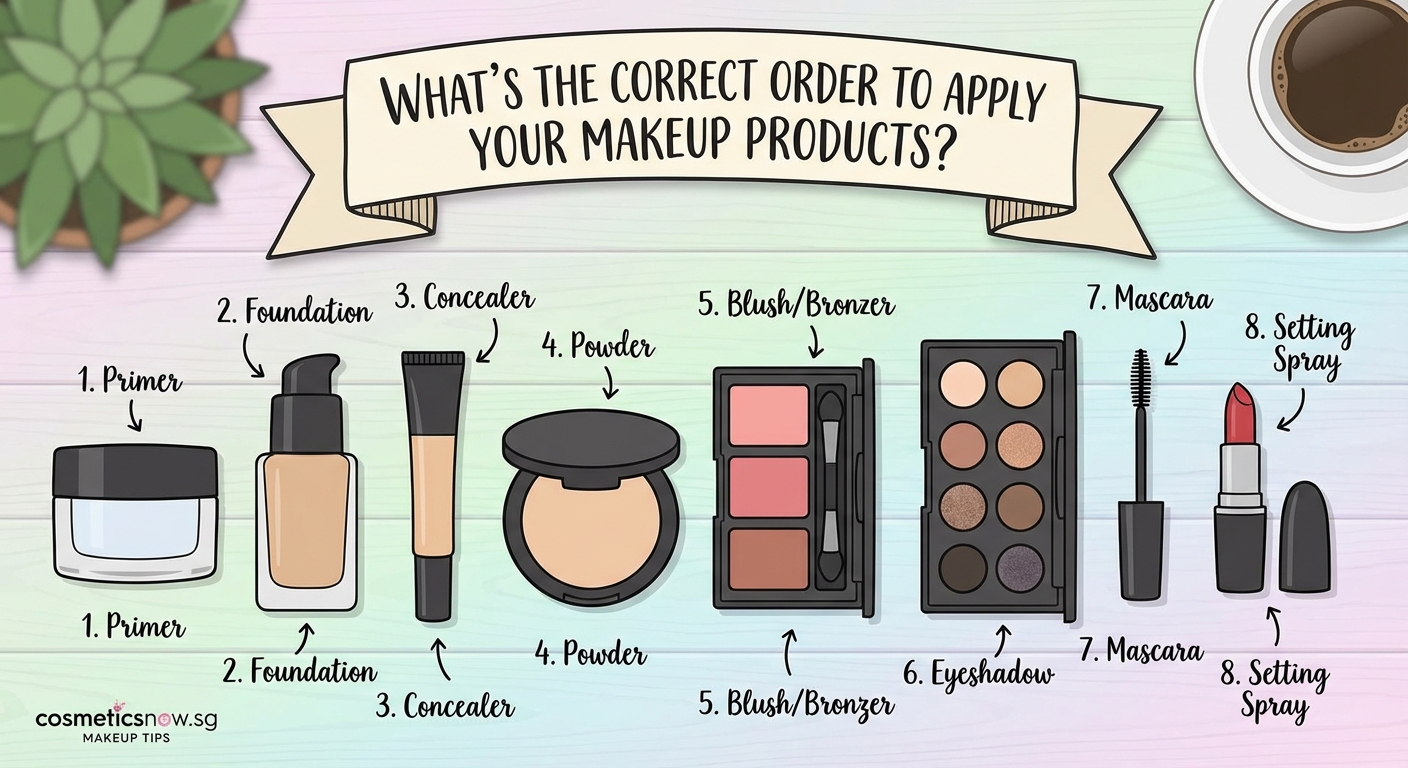
The correct order to apply makeup starts with skincare, then primer, followed by base products like foundation and concealer. Next come powder products for setting and definition, then eye makeup, and finally lips. This sequence ensures each product adheres properly, lasts longer, and creates a seamless finish that looks professional rather than cakey or uneven throughout your day.
Why the sequence of your makeup application actually matters
Think of makeup application like getting dressed. You wouldn’t put your shoes on before your pants, right?
The same logic applies to your face.
Each product has a specific texture and purpose. Liquids need to be applied before powders because powder over liquid creates a smooth canvas, while liquid over powder causes patchiness. Cream products blend best into bare or primed skin, not over set powder.
When you follow the correct order to apply makeup, each layer bonds properly with the one beneath it. Your foundation stays put instead of sliding around. Your blush blends seamlessly instead of sitting in streaks. Your entire look holds together for hours instead of breaking down after lunch.
Professional makeup artists follow this sequence for a reason. It’s not just tradition; it’s chemistry and physics working together.
Start with a clean, prepped canvas
Before any color touches your face, your skin needs proper preparation.
Wash your face with a gentle cleanser suited to your skin type. Pat dry with a clean towel.
Apply your complete skincare routine in this order:
- Toner or essence to balance your skin’s pH
- Serum to target specific concerns like dark spots or fine lines
- Eye cream applied with your ring finger using gentle tapping motions
- Moisturizer to hydrate and create a smooth surface
- Sunscreen as your final skincare step, even if you’re staying indoors
Wait three to five minutes after applying sunscreen. This allows everything to absorb and prevents your makeup from sliding around or pilling.
Your skin should feel hydrated but not greasy. If you have excess product sitting on the surface, gently blot with a tissue before moving forward.
The foundation layer builds everything else
Primer comes first in your makeup sequence.
Choose a primer based on your main concern. Pore-minimizing formulas work well for textured skin. Hydrating primers suit dry patches. Color-correcting primers neutralize redness or sallowness.
Apply primer only where you need it. Most people need it on the T-zone, but you might need it on your cheeks instead.
Wait two minutes for the primer to set before applying foundation.
Foundation application method matters as much as timing. Applying foundation properly prevents the cakey look that happens when you use too much product or the wrong tools.
Start with a small amount. You can always add more.
Apply foundation from the center of your face outward, blending down your neck to avoid a mask-like appearance. Use a damp beauty sponge, dense brush, or clean fingers depending on your preferred finish.
Concealer comes after foundation, not before. Foundation covers most imperfections, so you’ll need less concealer this way.
Apply concealer in an inverted triangle under your eyes, on any remaining blemishes, and around your nose if you have redness. Blend the edges so there’s no visible line where concealer meets foundation.
Powder products lock everything in place
Setting powder prevents your base from moving throughout the day.
Use a translucent powder if you want to maintain your foundation’s color. Use a tinted powder if you want additional coverage.
Apply powder only where you get oily or where you need extra longevity. For most people, this means the T-zone and under the eyes.
Use a fluffy brush and a light hand. Too much powder ages your skin and creates a flat, lifeless finish.
After setting powder, you can move to powder complexion products like bronzer, blush, and highlighter. These blend more easily over powder than over cream or liquid products.
| Product Type | Application Area | Common Mistake |
|---|---|---|
| Bronzer | Hollows of cheeks, temples, jawline | Applying too low on cheeks, creating a muddy look |
| Blush | Apples of cheeks blended toward temples | Placing too close to nose or too far toward ears |
| Contour | Under cheekbones, sides of nose, hairline | Using a shade that’s too warm or applying too heavily |
| Highlighter | High points that catch light naturally | Applying to areas with texture or large pores |
Contouring placement changes based on your face shape, but the order stays the same: bronzer, contour, blush, then highlighter.
Eye makeup comes before or after face makeup depending on the look
For everyday makeup, do your eyes after your face.
For dramatic eye looks with lots of fallout, do your eyes first. This lets you clean up any eyeshadow that drops onto your cheeks without ruining your foundation.
The correct order for eye products follows this sequence:
- Eyeshadow primer on lids and under eyes if you’re using lower lash line color
- Transition shade in the crease using a fluffy brush
- Lid color applied with a flat brush or your finger
- Darker shades for depth in the outer corner and crease
- Highlight shade on the inner corner and brow bone
- Eyeliner on the upper lash line, waterline, or both
- Mascara on upper lashes, then lower lashes
If you’re doing winged eyeliner, apply it after eyeshadow but before mascara. This prevents your lashes from getting in the way and creating a wobbly line.
Curl your lashes before mascara, never after. Curling mascara-coated lashes can break them.
Apply two thin coats of mascara rather than one thick coat. Let the first coat dry for 30 seconds before applying the second.
“The biggest mistake I see is people doing mascara first, then trying to apply eyeshadow. The fallout sticks to the mascara and creates a mess that’s nearly impossible to fix without starting over.” — Professional makeup artist with 15 years of experience
Eyebrows frame your entire face
Fill in your brows after completing your eye makeup but before moving to lips.
This placement in the sequence matters because you need to see your full eye look to determine how bold your brows should be. Dramatic eyes pair well with defined brows. Subtle eyes look better with softer brows.
Start by brushing your brows upward and outward with a clean spoolie. This shows you where you have sparse areas.
Fill in gaps using short, hair-like strokes rather than solid lines. Start in the middle of your brow and work toward the tail, then fill in the front last.
The front of your brow should be the lightest, with color gradually intensifying toward the arch and tail.
Set your brows with a clear or tinted brow gel to keep them in place all day.
Lips come last for good reason
Lipstick is always the final step in the correct order to apply makeup.
This placement prevents you from accidentally smudging lip color while applying other products. It also lets you see your complete look before choosing a lip shade.
Your lip color should balance your eye makeup intensity. Bold eyes typically pair with neutral lips. Dramatic lips work best with simpler eye looks.
Start with lip balm if your lips are dry, but blot away excess before applying color. Too much balm makes lipstick slide around.
Line your lips with a pencil that matches your natural lip color or your lipstick shade. This prevents feathering and makes your lipstick last longer.
Fill in your entire lip with the pencil if you want maximum staying power.
Apply lipstick with a brush for precision or directly from the bullet for ease. Blot with a tissue, apply a second coat, then blot again.
For long-lasting lip color, skip gloss or apply it only to the center of your lips for dimension without sacrificing wear time.
Common mistakes that ruin your makeup sequence
Skipping primer seems like a time saver but actually costs you longevity. Your makeup will break down faster without it.
Applying powder before liquid or cream products creates a barrier that prevents proper blending. The result looks patchy and uneven.
Using too much product at each step builds up and looks heavy. Start with less and add more only where needed.
Not letting products set between steps causes everything to mix together on your skin. Give each layer 30 seconds to a minute before adding the next.
Forgetting to blend your neck creates a visible line where your face ends. Always extend your foundation and powder slightly down your neck.
- Apply skincare and wait for absorption before starting makeup
- Use primer where you need it, not necessarily everywhere
- Build coverage gradually rather than starting with heavy application
- Set only the areas that need it to avoid a cakey finish
- Choose powder or cream blush based on whether you’ve set with powder
- Complete one area fully before moving to the next
Adjusting the order for different makeup styles
The basic sequence stays the same, but you can modify timing based on your look.
For natural makeup, you might skip primer and use tinted moisturizer instead of foundation. The order remains the same: skincare, tinted moisturizer, concealer if needed, cream blush, brow gel, mascara, lip balm.
For full glam, you’ll use every step but might do eyes first to avoid fallout on your finished base. Clean up any eyeshadow on your cheeks with a makeup wipe or micellar water before applying foundation.
For minimal morning routines, you can combine steps. Use a tinted moisturizer with SPF, cream blush that doubles as lip color, and a brow gel with fibers instead of separate pencil and gel.
The key is understanding why each product goes where it does. Once you grasp the logic, you can adapt the sequence to fit your needs without compromising the final result.
Setting spray seals everything together
The absolute final step is setting spray.
Hold the bottle eight to ten inches from your face. Close your eyes and mouth. Spray in an X pattern, then a T pattern to ensure even coverage.
Let the spray dry naturally. Don’t touch your face or fan it dry.
Setting spray melts all your layers together so they look like skin rather than separate products sitting on top of each other. It also extends wear time by creating a protective seal.
Choose a dewy setting spray for dry skin or a matte formula for oily skin. Some sprays offer both setting and priming benefits if you apply them before and after makeup.
Making the correct order work for your lifestyle
You don’t need to use every product every day.
On busy mornings, stick to the essentials: moisturizer, concealer, brow gel, mascara, lip color. This abbreviated routine still follows the correct order: skincare, base, brows, eyes, lips.
For special events, add the full sequence: primer, foundation, powder, bronzer, blush, highlighter, eyeshadow, liner, mascara, lips, setting spray.
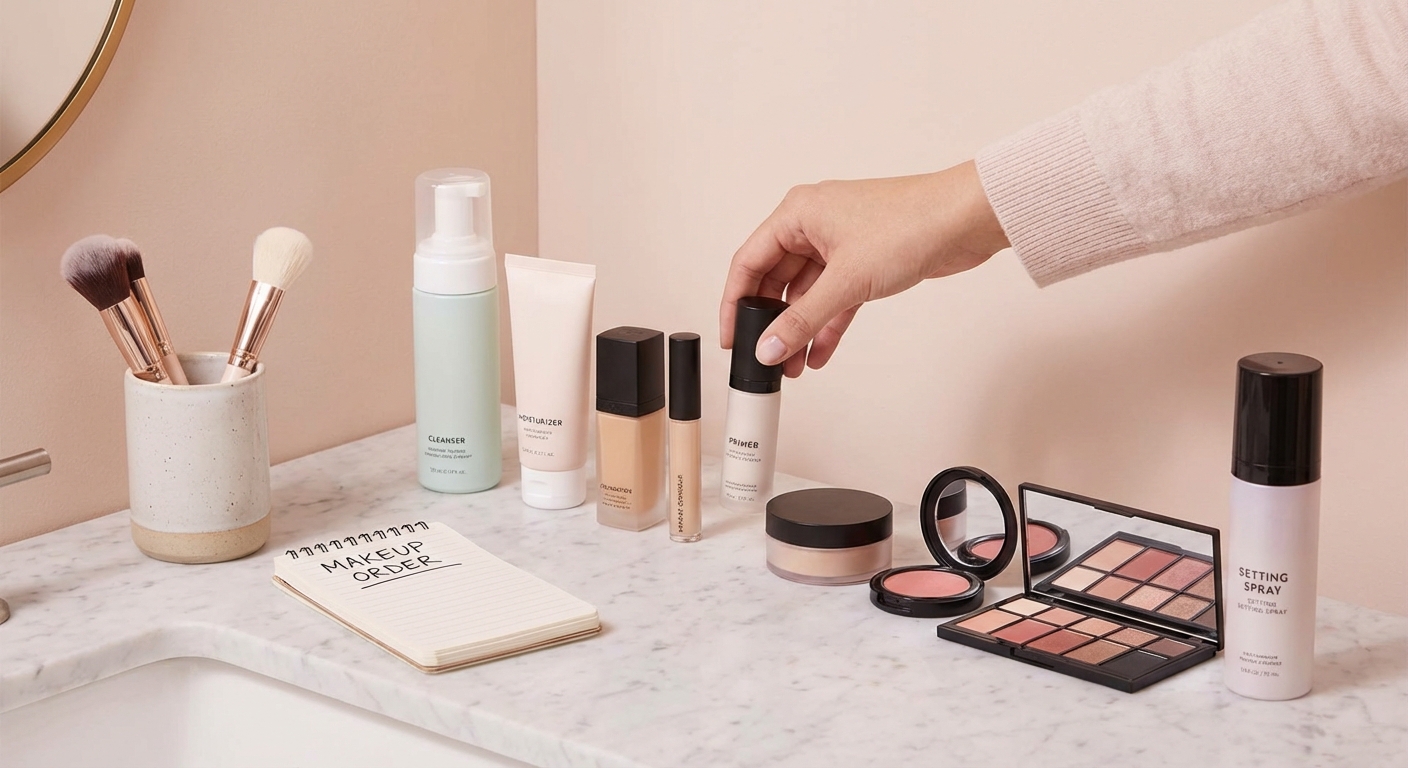
Keep your products organized in the order you use them. This eliminates decision fatigue and speeds up your routine.
Store skincare separately from makeup so you’re not tempted to skip the prep work. Your makeup will always look better on properly prepped skin.
Practice the sequence on weekends when you have more time. Muscle memory develops faster than you think, and soon you’ll move through the steps without conscious thought.
Building confidence through consistent application
Following the correct order to apply makeup transforms your results more than buying expensive products ever will.
You’ll notice your makeup lasts longer without touch-ups. Your skin looks smoother and more natural. Your features appear enhanced rather than covered.
Start with a simplified routine using just a few products in the right order. Add more steps as you build confidence and skill.
Take photos of your makeup in natural light to track your progress. You’ll see improvement within a week of following the proper sequence.
The correct order isn’t about rules for the sake of rules. It’s about chemistry, physics, and common sense working together to help you look your best. Master the sequence, and you’ll master your makeup.