Foundation after 50 isn’t about covering up. It’s about working with your skin’s natural texture to create a radiant, lifted appearance that celebrates where you are right now.
Your skin has changed, and that’s perfectly normal. Dryness, fine lines, and uneven texture require different techniques than what worked in your 30s. The good news? With the right approach, foundation can enhance your natural beauty without settling into creases or emphasizing texture.
Applying foundation over 50 requires hydration-focused prep, strategic product placement using pressing motions instead of dragging, and buildable coverage that respects your skin’s texture. Choose lightweight, luminous formulas and apply with a damp sponge or stippling brush. Focus on the center of your face where you need the most coverage, then blend outward for a natural finish that won’t settle into lines.
Understanding Your Skin After 50
Your skin produces less oil now than it did decades ago. This means foundation can cling to dry patches or emphasize texture if you’re not careful.
Collagen production has slowed down. Your skin is thinner and more delicate. Heavy, matte foundations that looked great in your 20s will now make you look older, not younger.
The goal isn’t perfection. It’s creating a smooth, even canvas that looks like skin, not a mask.
Many women make the mistake of using too much product or formulas that are too thick. Less is genuinely more after 50. Building coverage gradually gives you control and prevents that cakey appearance.
Prep Your Skin the Right Way

Foundation application starts long before you open the bottle.
Start with a hydrating cleanser. Pat your face dry gently. Never rub or pull at your skin.
Apply a hydrating serum next. Look for ingredients like hyaluronic acid or glycerin that draw moisture into your skin. Give it 60 seconds to absorb.
Your moisturizer is critical. Choose one formulated for mature skin with ingredients that plump and smooth. Wait three to five minutes before moving to the next step. This waiting period prevents your foundation from sliding around or mixing with your skincare.
Use a primer designed for mature skin. Skip the mattifying formulas. Instead, choose illuminating or hydrating primers that fill in fine lines and create a smooth surface. Apply it with your fingertips using gentle pressing motions.
Foundation on dry skin is like paint on an unprepared wall. It will show every crack and imperfection. Proper hydration is not optional.
If you want to build a solid foundation for your makeup routine, understanding the complete step-by-step guide to building your first skincare routine can transform your results.
Choosing the Right Foundation Formula
Not all foundations work well on mature skin.
Avoid matte foundations completely. They emphasize texture and make skin look flat and lifeless.
Look for these terms on the label:
– Luminous
– Radiant
– Hydrating
– Dewy
– Satin finish
Liquid foundations with a thin to medium consistency work best. They blend easily and won’t settle into lines.
Cream foundations can work if they’re specifically formulated to be lightweight. Test them on your jawline first. If they feel heavy or thick, skip them.
Stick foundations are tricky. Some work beautifully, but many are too dry for mature skin.
Powder foundations are generally not your friend after 50. They can look dusty and emphasize every line.
Coverage level matters too. Choose light to medium coverage formulas. You can always build up coverage where you need it, but you can’t easily remove excess product once it’s on.
When selecting your shade, the ultimate guide to choosing your perfect foundation shade will help you avoid common matching mistakes.
Step-by-Step Application Process
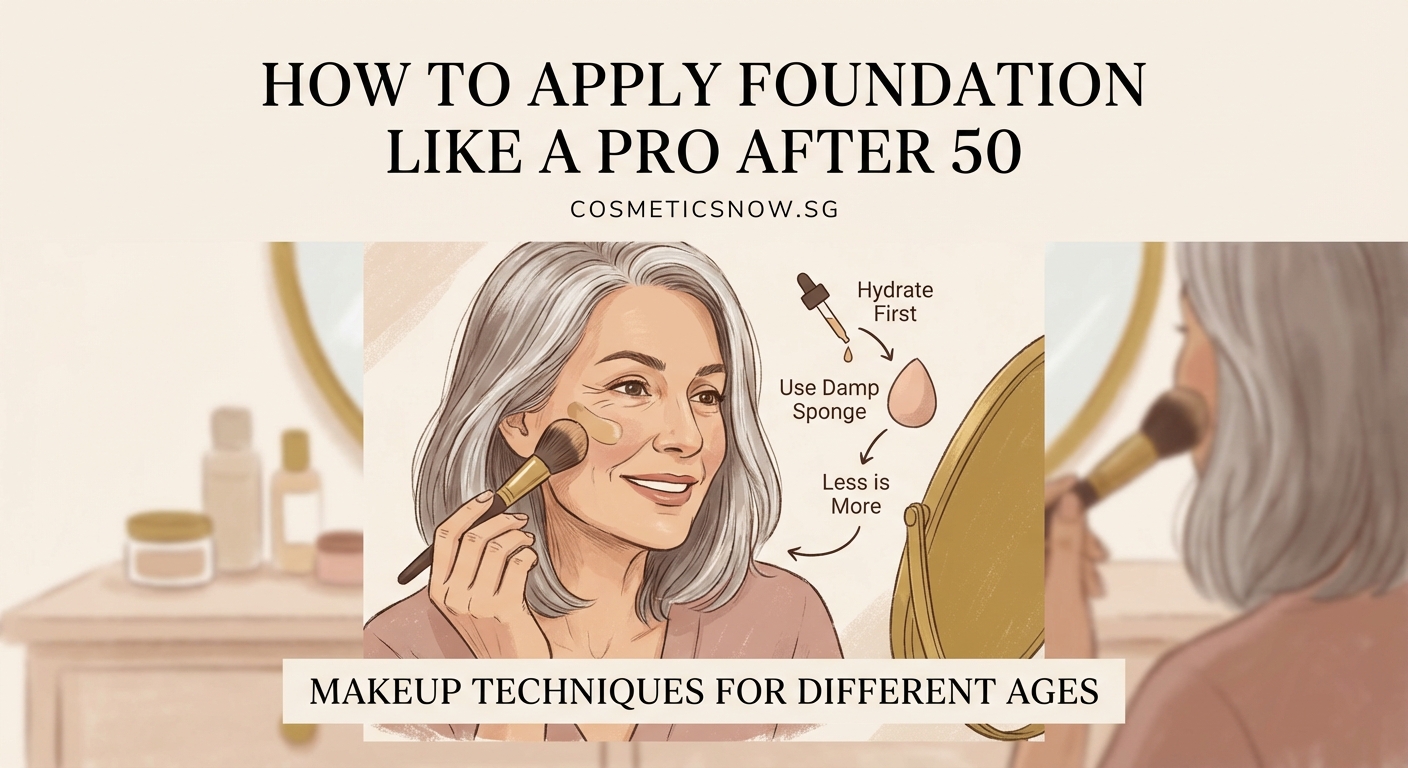
Here’s exactly how to apply foundation for the best results over 50.
1. Choose Your Tool
Your application method matters as much as the product itself.
A damp makeup sponge gives the most natural finish. Wet it thoroughly, then squeeze out excess water. The dampness helps sheer out the foundation and prevents it from looking heavy.
A stippling brush (the kind with duo-fiber bristles) also works beautifully. It deposits product without dragging across your skin.
Your fingers can work for some formulas, especially if you have good technique. The warmth helps blend the product seamlessly.
Avoid flat foundation brushes. They tend to show streaks and can emphasize texture.
2. Apply Foundation Strategically
Don’t cover your entire face with the same amount of product.
Start with a small amount. You can always add more.
Place dots of foundation on these areas:
– Center of forehead
– Bridge of nose
– Cheeks near your nose
– Chin
Notice what’s missing? The outer edges of your face. You’ll blend the product outward, but you don’t need full coverage everywhere.
3. Blend Using the Right Technique
This is where most people go wrong.
Press and roll your sponge or stipple with your brush. Never drag or wipe across your skin. Dragging pulls at delicate skin and pushes foundation into lines.
Start from the center of your face and work outward. Use gentle pressing motions to blend the product into your skin.
Pay special attention to your jawline. Blend downward onto your neck slightly to avoid a visible line of demarcation.
Around your eyes, use an even lighter hand. The skin here is the most delicate and prone to creasing.
4. Build Coverage Where Needed
After your first layer, step back and assess.
Do you have areas that need more coverage? Dark spots, redness, or uneven tone?
Add a tiny bit more foundation only to those specific areas. Blend carefully using the same pressing technique.
For stubborn spots, a concealer works better than more foundation. Choose one that’s hydrating and only slightly lighter than your foundation.
5. Set Strategically
Setting powder is controversial for mature skin, but used correctly, it helps foundation last.
Use a finely milled, translucent powder. Avoid anything with shimmer or color.
Only set the areas that tend to get oily or where makeup creases. For most women over 50, that’s the T-zone and under eyes.
Use a fluffy brush and the lightest possible hand. Gently press the powder into your skin rather than sweeping it on.
Skip powder on your cheeks, temples, and jawline. These areas benefit from the natural luminosity of your foundation.
Common Mistakes to Avoid
| Mistake | Why It’s a Problem | Better Approach |
|---|---|---|
| Using too much product | Settles into lines and looks heavy | Start with less than you think you need |
| Applying foundation to dry skin | Clings to flakes and emphasizes texture | Always prep with hydration first |
| Dragging or wiping motions | Pulls delicate skin and pushes product into creases | Use pressing, stippling, or rolling motions |
| Matching foundation to your hand | Hands are often darker or different undertones | Test on your jawline or neck |
| Full coverage everywhere | Looks mask-like and ages you | Build coverage only where needed |
| Matte formulas | Make skin look flat and emphasize wrinkles | Choose luminous or satin finishes |
| Skipping primer | Foundation has nothing to grip and may slide | Use a hydrating, smoothing primer |
Addressing Specific Concerns
Fine Lines and Wrinkles
Foundation doesn’t cause wrinkles, but it can emphasize them if applied incorrectly.
Never apply foundation directly over dry patches near lines. Exfoliate gently the night before and apply extra moisturizer to these areas.
Use less product around your eyes and mouth where lines are most prominent. Sometimes, a tinted moisturizer or BB cream works better in these areas than full foundation.
If foundation settles into smile lines, you’re using too much product or the wrong formula. Switch to something more lightweight.
Uneven Texture
Enlarged pores and rough texture are common after 50.
A smoothing primer helps, but technique matters more. Stippling foundation into the skin rather than brushing it across helps minimize the appearance of texture.
Avoid formulas with large shimmer particles. They highlight texture rather than hiding it. Look for products described as “soft focus” or containing light-reflecting particles instead.
Age Spots and Hyperpigmentation
Foundation alone won’t cover dark spots completely, and that’s okay.
Apply your foundation as usual, then use a targeted concealer on spots. Choose a peachy or orange-toned corrector first if your spots are very dark, then apply a skin-toned concealer over it.
Pat the concealer on with your ring finger or a small brush. Set it with a tiny amount of powder to prevent it from moving.
For an overall more even complexion, consider how to properly layer your serums for maximum skin benefits to address pigmentation from the inside out.
Dry Patches
Dry skin and foundation are not friends.
Exfoliate regularly but gently. Use a chemical exfoliant with lactic acid or enzymes rather than harsh scrubs that can damage mature skin.
If you notice foundation clinging to dry areas, stop and remove it. Apply more moisturizer, wait a few minutes, then try again with less product.
Keep a facial mist at your vanity. If foundation starts to look dry as you’re applying it, spritz your face lightly and continue blending.
Tools That Make a Difference
The right tools transform your application.
Beauty sponges: Replace them every three months. Wash after each use with gentle soap. The dampness is key to their effectiveness.
Stippling brushes: Wash weekly with brush cleaner. The duo-fiber bristles pick up just the right amount of product.
Setting spray: Use before and after foundation. A hydrating setting spray before foundation helps it meld with your skin. After application, it removes any powdery finish.
Magnifying mirror: Use it for precision work like concealing, but step back to a regular mirror to check your overall look. Magnification can make you over-apply.
Good lighting: Natural light is best. If that’s not possible, use daylight-balanced bulbs. Yellow-toned lighting makes everything look warmer than it actually is.
Making Your Foundation Last
Foundation that looks beautiful at 8am but patchy by noon defeats the purpose.
Start with skincare that creates a stable base. If your moisturizer is too rich or hasn’t absorbed, foundation will slide around.
Use primer on areas that tend to get oily or where makeup fades first.
Set strategically as mentioned earlier. Too much powder ages you, but none at all means your foundation won’t last.
Blotting papers are your friend. If you get shiny during the day, blot rather than adding more powder.
Carry a small facial mist. A light spritz refreshes your makeup and adds back hydration that air conditioning steals.
Touch up with a damp sponge rather than adding more product. Press the sponge over areas that have faded to blend and smooth.
Adapting Techniques for Different Occasions
Your foundation needs change based on what you’re doing.
Daily wear: Sheer coverage with emphasis on skin prep. Skip powder except on your T-zone. The goal is looking like yourself, just more polished.
Special events: You can use slightly more coverage and set more thoroughly for photos. Flash photography can wash you out, so don’t go too light with your shade choice.
Video calls: Avoid anything with SPF that contains zinc oxide or titanium dioxide. These ingredients cause flashback on camera, making you look ghostly. Matte formulas actually work better on video, but keep them light.
Outdoor activities: Use a foundation with SPF as a bonus layer of protection, but never as your only sunscreen. Set well so it doesn’t budge with light perspiration.
Understanding why your makeup routine should change every decade helps you adapt your approach as your needs continue to evolve.
Beyond Foundation Application
Foundation is just one piece of the puzzle.
Your overall makeup application affects how your foundation looks. Heavy eye makeup or dark lips can make your foundation look too light or too heavy by comparison.
The rest of your routine matters too. What’s the correct order to apply your makeup products? can help you understand how each step builds on the previous one.
Removing your makeup properly at night prevents buildup and keeps your skin healthy. The right way to remove makeup without damaging your skin protects your skin barrier and prevents irritation.
Your nighttime routine supports your daytime makeup. When you build a nighttime skincare routine for every skin type, you’re investing in how your foundation will look tomorrow.
Product Recommendations by Skin Type
Dry skin: Look for foundations with hyaluronic acid, glycerin, or oils in the ingredient list. Formulas described as “hydrating” or “moisturizing” are your best bet.
Combination skin: Stick with lightweight, buildable formulas. You might need to set your T-zone but leave the rest dewy.
Sensitive skin: Fragrance-free formulas with minimal ingredients reduce the risk of irritation. Mineral foundations can work well, but choose liquid versions rather than powder.
Oily patches: Even mature skin can have oily areas. Use a mattifying primer only on those specific zones, then apply your luminous foundation over the entire face.
Troubleshooting Common Issues
Foundation looks orange: Your undertone is wrong. If you’re cool-toned, you need pink or neutral undertones in your foundation. Warm-toned skin needs yellow or golden undertones.
Makeup separates or gets patchy: Your skincare and foundation aren’t compatible. Water-based products don’t play well with silicone-based ones. Check your ingredients.
Foundation emphasizes pores: You’re using too much or the wrong formula. Try a pore-filling primer and a more liquid foundation applied with a damp sponge.
Looks cakey by midday: You’re using too much powder or your skin is dehydrated. Drink more water, use a hydrating mist, and reduce powder application.
Foundation disappears: You need a primer to help it adhere, or you’re not setting it at all. Find the middle ground between no powder and too much.
Your Foundation Routine Moving Forward
Applying foundation over 50 doesn’t have to be complicated or time-consuming.
The key principles are simple. Hydrate thoroughly first. Choose lightweight, luminous formulas. Apply with pressing motions, not dragging. Build coverage where you need it. Set only where necessary.
Your skin is beautiful exactly as it is. Foundation is simply a tool to even out your complexion and enhance your natural radiance.
Practice these techniques, and you’ll find your application time actually decreases. You’ll use less product, get better results, and feel more confident in how your skin looks.
Start tomorrow morning with these steps. Take your time. Be gentle with your skin. And remember that the goal is to look like the best version of yourself, not someone else entirely.