You look in the mirror and notice your favorite eyeshadow technique suddenly emphasizes lines you never saw before. Your go-to foundation settles into creases that weren’t there last year. The lipstick shade that made you feel confident now drains your complexion. Your skin has changed, and your makeup needs to change with it.
As skin matures, it requires different makeup approaches to enhance natural beauty. Foundation formulas should become more hydrating, application techniques gentler, and color choices warmer. The techniques that worked beautifully at 25 can add years to your appearance at 45. Understanding how to adjust your routine for each decade helps you look polished, current, and confident at any age.
Understanding Why Skin Changes Require Different Makeup Approaches
Your skin undergoes significant transformations as you age. Collagen production slows down starting in your late 20s. Oil production decreases, leaving skin drier. Cell turnover slows, creating a duller complexion.
These changes aren’t flaws. They’re natural progressions that simply require different strategies.
Makeup that worked perfectly on plump, oily skin can look cakey on mature, dry skin. Heavy powder that once controlled shine now settles into fine lines. Matte formulas that created a flawless finish can emphasize texture.
The good news? Adjusting your approach makes a dramatic difference. Small tweaks to your complete step-by-step guide to building your first skincare routine create the foundation for better makeup application.
Your 30s: Transitioning From Youthful to Sophisticated
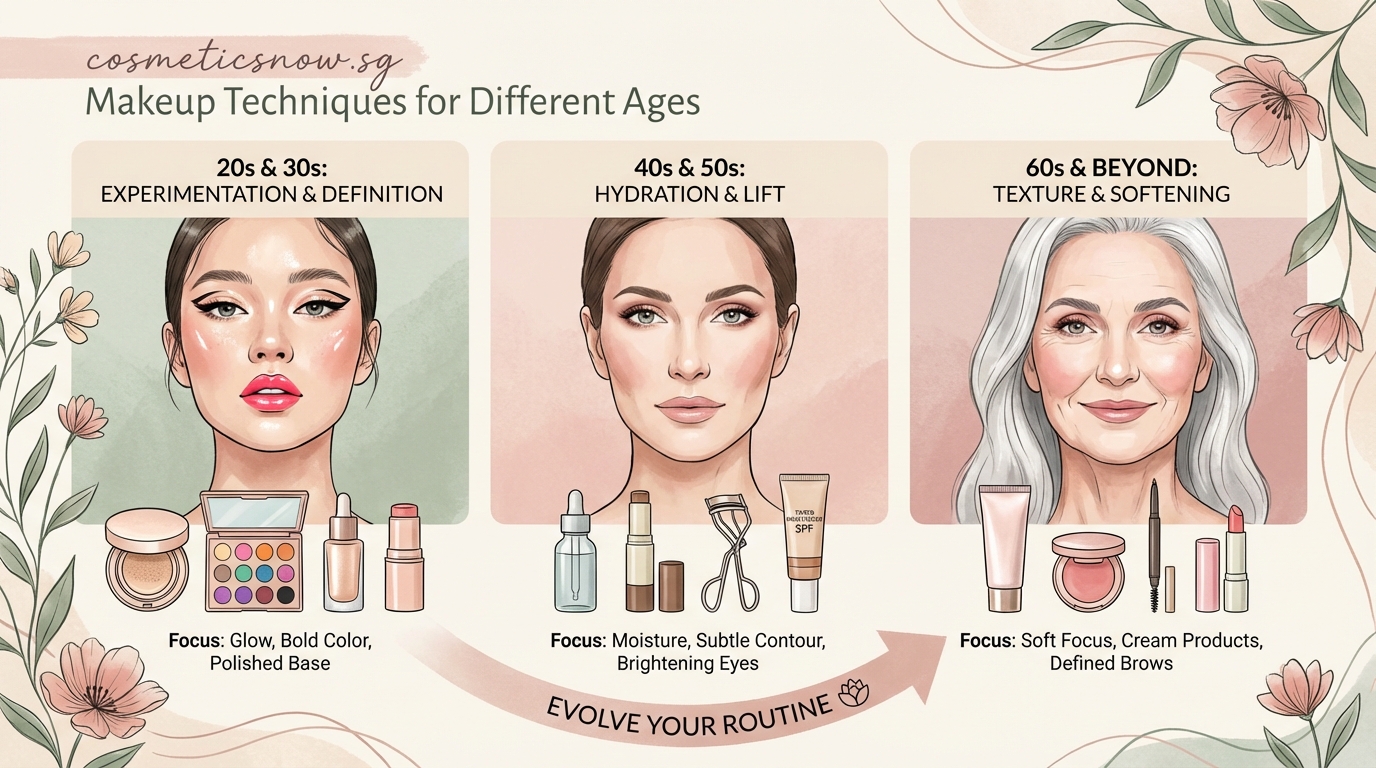
Your 30s mark the beginning of visible changes. Fine lines appear around your eyes. Your skin may become drier or show uneven tone.
This decade calls for prevention and adjustment.
Foundation Changes for Your 30s
Switch from matte to satin finish foundations. These provide coverage without emphasizing texture. Look for formulas with hyaluronic acid or glycerin.
Apply foundation with a damp beauty sponge instead of brushes. This creates a more natural finish and prevents product from settling into emerging fine lines.
Skip heavy powdering. Use powder only where you get oily, typically the T-zone. The rest of your face benefits from a natural, slightly dewy finish.
Eye Makeup Adjustments
Your eyelids may start showing slight crepiness. This means shimmer placement becomes critical.
Place shimmer only on the center of your lid, not in the crease. Dark matte shades still work beautifully for definition, but blend them thoroughly.
Winged eyeliner for beginners can still be stunning, but keep the line thinner and closer to your lash line.
Lip Color Evolution
Your natural lip color may fade slightly. Choose lip colors one shade deeper than what you wore in your 20s.
Cream formulas work better than matte liquids, which can emphasize any fine lines developing around your mouth.
“The biggest mistake women make in their 30s is continuing their exact same routine from their 20s. Small adjustments now prevent you from looking dated later.” – Celebrity makeup artist Lisa Eldridge
Your 40s: Embracing Radiance and Warmth
The 40s bring more pronounced changes. Skin loses elasticity. Pigmentation becomes uneven. Dryness increases significantly.
Your makeup strategy needs to prioritize hydration and light.
Foundation Strategies That Actually Work
How to apply foundation like a professional makeup artist becomes even more important now. Your application technique matters as much as the product.
Choose lightweight, buildable foundations. Heavy coverage emphasizes texture rather than hiding it.
Mix a drop of facial oil into your foundation. This creates a luminous finish and prevents the makeup from clinging to dry patches.
Apply foundation in thin layers, building coverage only where needed. Most women need more coverage around the nose and chin, less on the cheeks.
The Critical Eye Area
Your eyes show age faster than any other feature. But harsh techniques make this worse.
- Use cream eyeshadows instead of powder formulas
- Apply a light, reflective shade on the inner corner to brighten
- Keep darker shades below the crease, not in it
- Use brown or charcoal eyeliner instead of black for a softer look
- Curl lashes before applying mascara to open up the eye area
Avoid applying dark shadow all the way to your brow bone. This creates a heavy, dated look.
Contouring Adjustments for Mature Skin
Contouring techniques that actually work for your 40s differ significantly from techniques designed for younger skin.
Use cream products, not powder. They blend more naturally and don’t settle into lines.
Apply contour higher on your cheekbones than you did in your 30s. As skin loses volume, lower placement can drag your features down visually.
Skip contouring around your nose and jawline. Focus only on adding subtle dimension to cheeks.
Your 50s and Beyond: Mastering Refined Elegance
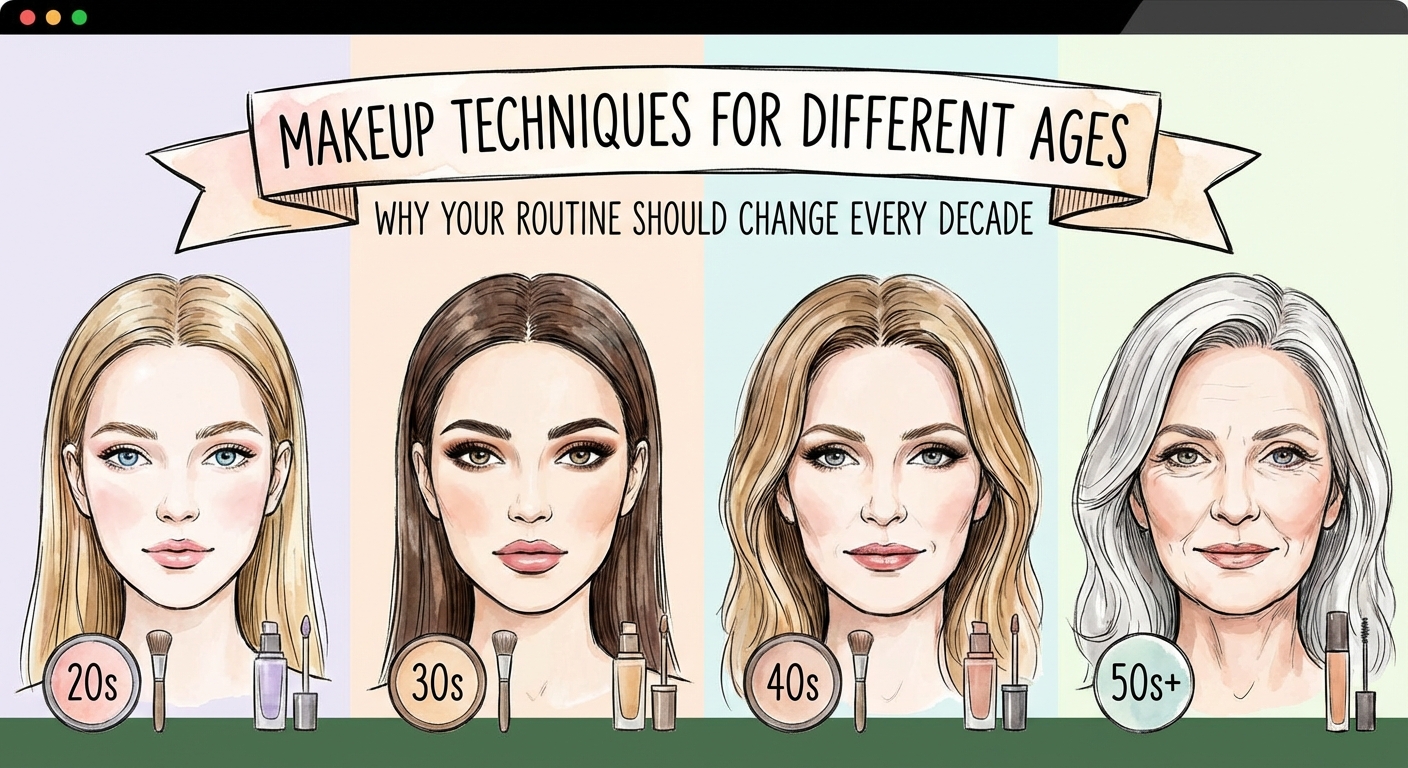
Your 50s require the most significant routine adjustments. Skin becomes thinner, drier, and more delicate. Pigmentation changes become more pronounced.
This decade is about enhancing your natural features with the lightest touch possible.
Foundation Application After 50
How to apply foundation like a pro after 50 focuses on strategic coverage rather than full coverage.
- Start with a hydrating primer that fills in fine lines
- Apply foundation only where you need it, using your fingers for the most natural finish
- Use concealer strategically under eyes and on any spots
- Set only the under-eye area with a light dusting of translucent powder
- Finish with a hydrating setting spray to meld everything together
Never apply foundation all over your face. This creates a mask-like appearance on mature skin.
Eye Makeup That Lifts and Brightens
Your eyes need techniques that counteract drooping and create the illusion of lift.
Apply eyeshadow with your eyes open. This shows you exactly where color will be visible and prevents wasted product in the crease.
Use only matte or satin finishes. Skip shimmer entirely on the lid. If you want sparkle, place it only in the inner corner.
Line only the outer two-thirds of your upper lash line. Extend the line slightly upward at the outer corner to create lift.
Skip lower lash liner completely. It closes off the eye and makes you look tired.
Lip Color Choices That Flatter
Your lips lose volume and color with age. The wrong lip color can drain your entire face.
Choose lipsticks with warm undertones. Cool pinks and berries can make mature skin look gray.
5 game-changing lip colors for women over 60 provides specific shade recommendations, but the principle remains the same: warm, medium-depth colors work best.
Use a lip liner in a shade matching your natural lip color. Line just outside your natural lip line to restore lost volume.
Choose cream or satin finishes. Avoid matte liquid lipsticks, which emphasize every line and can be drying.
Common Mistakes That Add Years to Your Appearance
Certain makeup choices age you regardless of your actual age. These mistakes become more pronounced as skin matures.
| Aging Mistake | Why It Ages You | Better Alternative |
|---|---|---|
| Heavy powder all over face | Settles into lines, creates texture | Powder only T-zone, use setting spray elsewhere |
| Dark lip liner with lighter lipstick | Dated, harsh, emphasizes lip lines | Lip liner matching lipstick or natural lip color |
| Harsh black eyeliner all around eyes | Closes off eyes, looks heavy | Brown or charcoal on upper lid only |
| Overly matte foundation | Emphasizes dry patches and texture | Satin or luminous finish foundation |
| Powder eyeshadow on crepe lids | Settles into lines, looks chalky | Cream eyeshadow formulas |
| Overly warm or orange bronzer | Looks muddy on mature skin | Cool-toned contour or skip entirely |
Stop making these 10 common makeup mistakes that age you covers additional pitfalls to avoid.
Product Texture Changes Through the Decades
The formulas you choose matter as much as the colors.
Your 30s: Transition from powder to cream products gradually. You can still use powder eyeshadow, but incorporate cream blushes.
Your 40s: Make cream and liquid products your primary choices. Use powder only for setting specific areas.
Your 50s and beyond: Choose cream, liquid, and stick formulas almost exclusively. These blend seamlessly into mature skin without emphasizing texture.
This progression keeps your makeup looking fresh and natural rather than cakey or heavy.
Color Adjustments for Changing Skin Tone
Your skin tone shifts as you age. What changes?
- Natural melanin production decreases
- Blood vessels become more visible
- Yellow or sallow undertones can develop
- Redness may increase around the nose and cheeks
These changes require warmer makeup colors than you wore when younger.
Foundation should have slightly warmer undertones than your exact skin tone. This counteracts the sallowness that develops with age.
Blush should move from cool pinks to warm peaches and corals. These shades bring life back to the complexion.
Eyeshadow palettes should include more warm browns, taupes, and bronze shades. Cool grays can make mature skin look tired.
Application Techniques That Work Better on Mature Skin
How you apply makeup matters more than what you apply.
Stippling instead of rubbing: Pat products onto skin rather than rubbing them in. This prevents pulling delicate skin and creates a more natural finish.
Building coverage gradually: Apply thin layers and build up coverage only where needed. One heavy layer always looks worse than multiple thin layers.
Blending upward and outward: Always blend makeup in an upward direction. This creates subtle lift rather than dragging features down.
Using less product: Mature skin needs less product than young skin. More makeup settles into lines and emphasizes texture.
Setting strategically: Only set areas that need it. Over-setting creates a dry, aged appearance.
Tools and Brushes for Different Decades
Your makeup tools should evolve along with your techniques.
Damp beauty sponges work better than brushes for foundation on mature skin. They create a more natural finish and don’t emphasize texture.
Synthetic brushes work better than natural hair for cream products. They pick up and deposit product more effectively.
Smaller brushes give you more control for precise application. Large, fluffy brushes can look messy on mature features that need definition.
Replace brushes and sponges more frequently. Old tools harbor bacteria that mature skin is more susceptible to.
Building a Simplified Routine for Each Decade
Your routine should actually get simpler as you age, not more complicated.
Streamlined 30s Routine
- Hydrating primer
- Medium coverage foundation
- Concealer where needed
- Cream blush
- Neutral eyeshadow
- Mascara
- Cream lipstick
Efficient 40s Routine
- Illuminating primer
- Lightweight foundation applied strategically
- Brightening concealer
- Cream contour (optional)
- Cream blush
- Simple eye look with 2-3 shades
- Brown eyeliner
- Mascara
- Lip liner and lipstick
Refined 50+ Routine
- Hydrating, line-filling primer
- Foundation on center of face only
- Strategic concealer
- Cream blush
- One-shadow eye look or bare lid with liner
- Mascara on upper lashes only
- Lip liner and creamy lipstick
Notice how the routines become more focused and strategic rather than more complex.
Seasonal Adjustments for Mature Skin
Your skin’s needs change with the seasons, requiring routine adjustments.
Winter demands more hydration. Switch to even dewier foundations and add facial oil to your routine.
Summer requires lighter coverage. Use tinted moisturizer instead of foundation and cream products that won’t melt.
How to transition your makeup routine from summer to fall without buying everything new provides practical guidance for seasonal switches.
Skincare as the Foundation for Better Makeup
Your makeup only looks as good as the skin underneath it.
How to properly layer your serums for maximum skin benefits helps create the smooth canvas mature skin needs.
Prioritize these skincare elements:
- Gentle exfoliation 2-3 times weekly to remove dead skin cells
- Hyaluronic acid serum for plumping hydration
- Retinol or peptides for cell turnover and firmness
- Rich moisturizer to prevent makeup from clinging to dry patches
- SPF daily to prevent further damage
Better skincare means you need less makeup to look polished.
Making Peace With Your Changing Face
The hardest part of adjusting your makeup routine isn’t learning new techniques. It’s accepting that your face has changed.
You’re not trying to look 25 again. You’re trying to look like the best version of yourself right now.
That means letting go of techniques and products that no longer serve you, even if you loved them for years.
It means being willing to experiment and potentially fail as you figure out what works for your current skin.
It means recognizing that the goal isn’t to hide your age but to look polished, current, and confident.
Your Makeup Journey Continues
Your relationship with makeup should evolve just like every other part of your life. The techniques that worked beautifully at one stage become less effective at another, and that’s perfectly normal.
Start with one small change. Maybe it’s switching your powder foundation to a liquid formula. Perhaps it’s trying a cream blush instead of powder. Or simply applying your current products with a lighter hand.
Pay attention to how these changes make you look and feel. Your mirror will tell you what’s working.
The right makeup approach for your current age helps you look refreshed, polished, and like yourself. Not like you’re trying too hard or stuck in the past. Just beautifully, confidently you.